Flora canaria > Especies silvestres
Furcraea foetida
Furcraea foetida (L.) Haw
Familia
AGAVACEAE
Pitera, Pita, Cabuya
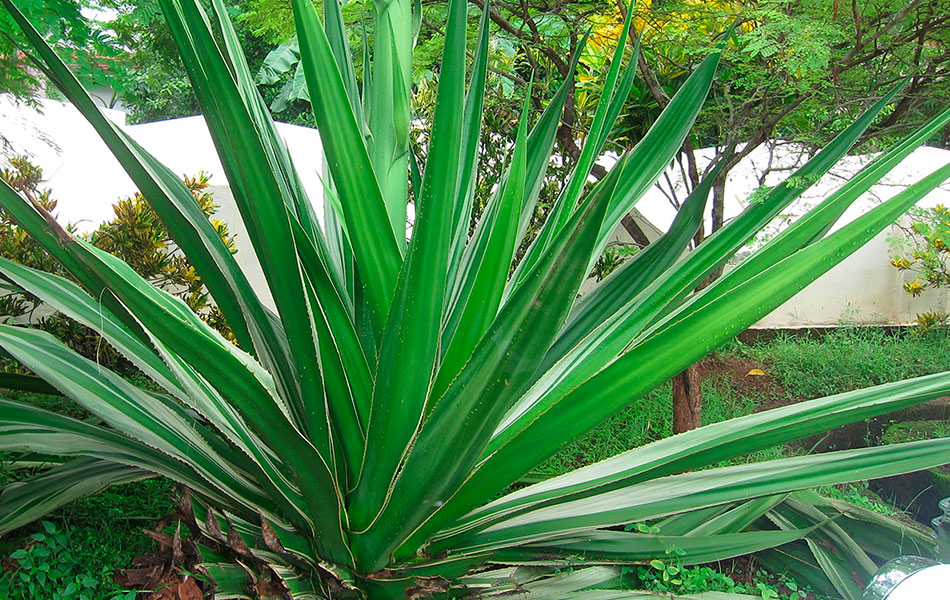
It is often confused with agaves due to its striking rosette-like appearance, but it differs in having softer, more flexible, textured leaves that are generally devoid of sharp marginal spines.
The leaves grow in a large basal rosette, reach between 1 and 2 metres in length and are bright green in colour. The popular cultivated variety ‘Mediopicta’ is distinguished by a central band of creamy yellow or ivory colour.
It is a monocarpic plant (it flowers only once at the end of its life). It develops a spectacular flower stalk that can reach between 6 and 9 metres in height, bearing greenish-white flowers that give off a strong, characteristic odour (hence its specific name ‘foetida’).
It produces an abundance of small offshoots or ‘bulbils’ on its flower stalk, which fall to the ground and root easily to give rise to new plants.
It is widely used as an ornamental plant in low-maintenance gardens, xeriscaping and large planters due to its high architectural value and drought resistance.
Historically, and in various regions of Latin America and the Old World, its leaves have been processed to extract a strong fibre used in the manufacture of ropes, sacks and handicrafts.
In some regions outside its native range (such as parts of South Africa, Hawaii, Australia and the Canary Islands), it has become strongly naturalised and is classified as an invasive alien species due to its high rate of spread, displacing the local flora.
El Hierro, La Palma, Tenerife, Gran Canaria, Fuerteventura