Flora canaria > Especies silvestres
Agave sisalana
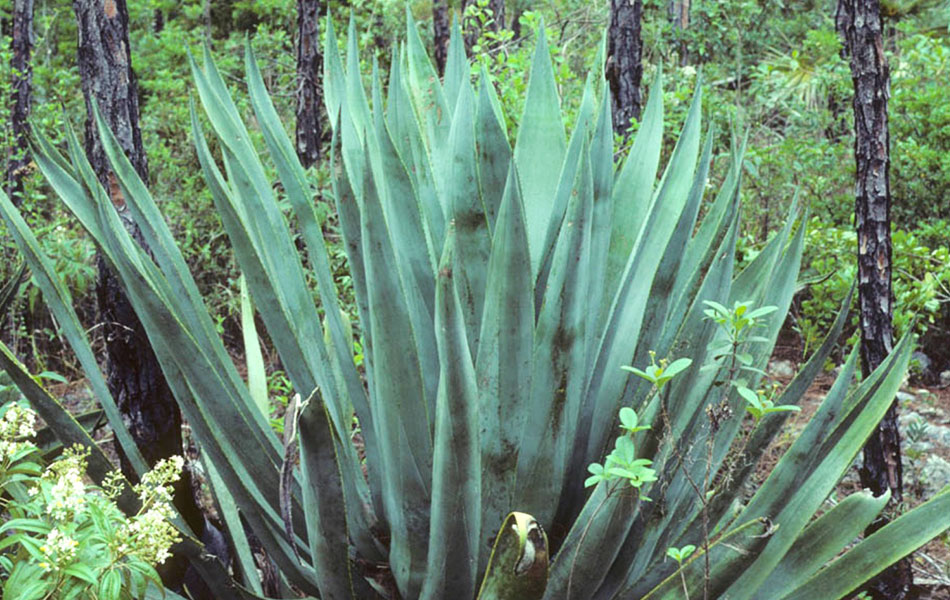
Agave sisalana (Engelm.) Perr.
Familia
AGAVACEAE
Sisal, Henequén, Maguey
Agave sisalana, commonly known as sisal or henequen, is a species of succulent plant native to southern Mexico (particularly the Yucatán region). It is world-famous and cultivated for the high commercial value of its fibres, which are extracted from the leaves to make ropes, twine, sacks, rugs and handcrafted textiles.
It develops a dense rosette of rigid, sword-shaped leaves, measuring between 1 and 1.5 metres in length. The leaves are greyish-green in colour and usually lack spines along the margins, but end in a sharp terminal spine.
The plant lives for between 7 and 10 years on average. Towards the end of its life, it produces a huge flower stalk (escape) that can reach up to 6 metres in height. Once it has flowered and set seed, the plant dies.
Although it flowers, it rarely produces viable seeds; instead, it reproduces via small bulbils (seedlings) that fall from the flower stalk or through offshoots that sprout from its base.
The leaves contain around 4 per cent fibre. The processing involves mechanical de-barking to separate the pulp from the fibre strands. Once washed and sun-dried, the fibres take on a very distinctive creamy-white colour and are notable for their resistance to tension and to degradation by salt water.
Globally, major producers such as Brazil and Tanzania lead the agro-industrial market for this plant. Furthermore, due to its hardiness and drought resistance, in some arid regions it is used as an ornamental plant or as a protective living barrier.
El Hierro, La Palma, La Gomera, Tenerife, Gran Canaria, Fuerteventura, Lanzarote