Flora canaria > Especies silvestres
Agave fourcroydes
Agave fourcroydes Lem.
Familia
AGAVACEAE
Henequén, Sisal, Pitera
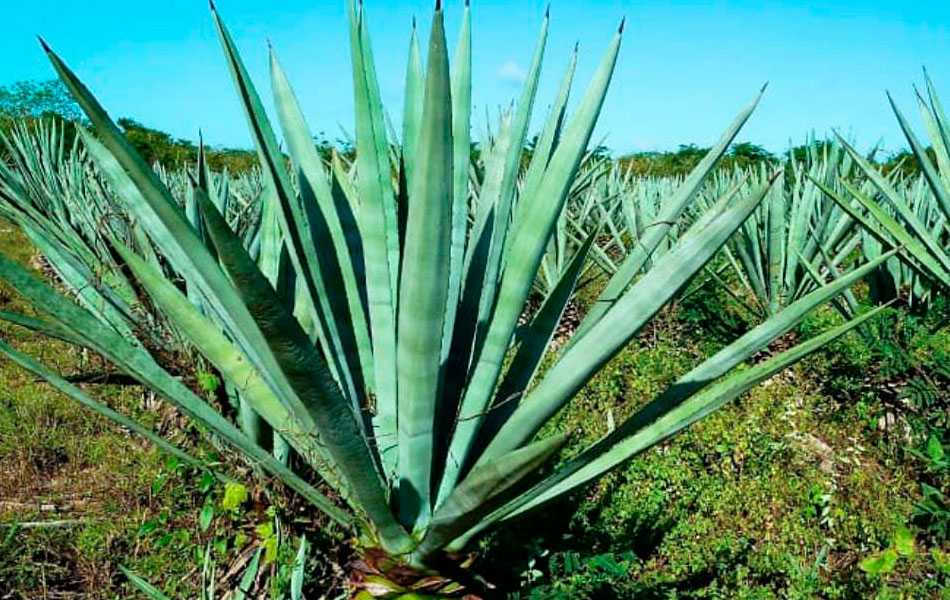
It is a monocarpic species that forms a rosette up to 2.5 m (metres) in diameter. Occasionally, it develops a sturdy trunk that can reach 1–2 m in height; in large rosettes, it has shoots.
Leaves 120–180 × 7–12 cm (centimetres), straight, rigid, linear, sword-shaped, broadly rounded at the base, grey-glaucous to pale green; spine 2–3 cm long, robust, conical, distinctly short, grooved above the base, somewhat decurrent; margins straight; teeth spaced 1–3 cm apart, slender, dark brown.
The inflorescence is a panicle reaching 5 to 6 m in height. Flowers (5–)6–7 cm in diameter, yellowish-green; tube 12–16 × 12–15 mm (millimetres); tepals 16–18 × 3–5 mm, linear; filaments 45–60 cm, robust, inserted 6–8 mm above the base of the tube; anthers 20–24 mm; ovary (20–)30–40 mm, fusiform.
This agave is native to and is mainly cultivated in Yucatán, Mexico, for the fibre contained in its leaves, which is used to make rigging, ropes, twine for boats, carpets, sacks or bags for packing and transporting grains, cereals and seeds such as rice, beans and maize, and for the manufacture of textiles. The areas of Yucatán where cultivation has been most intensive are those around the state capital, Mérida, and the municipalities of Motul, Izamal and Tixkokob, in particular.
La Palma, La Gomera, Tenerife, Gran Canaria, Fuerteventura, Lanzarote